best free AI text to speech tools for educators
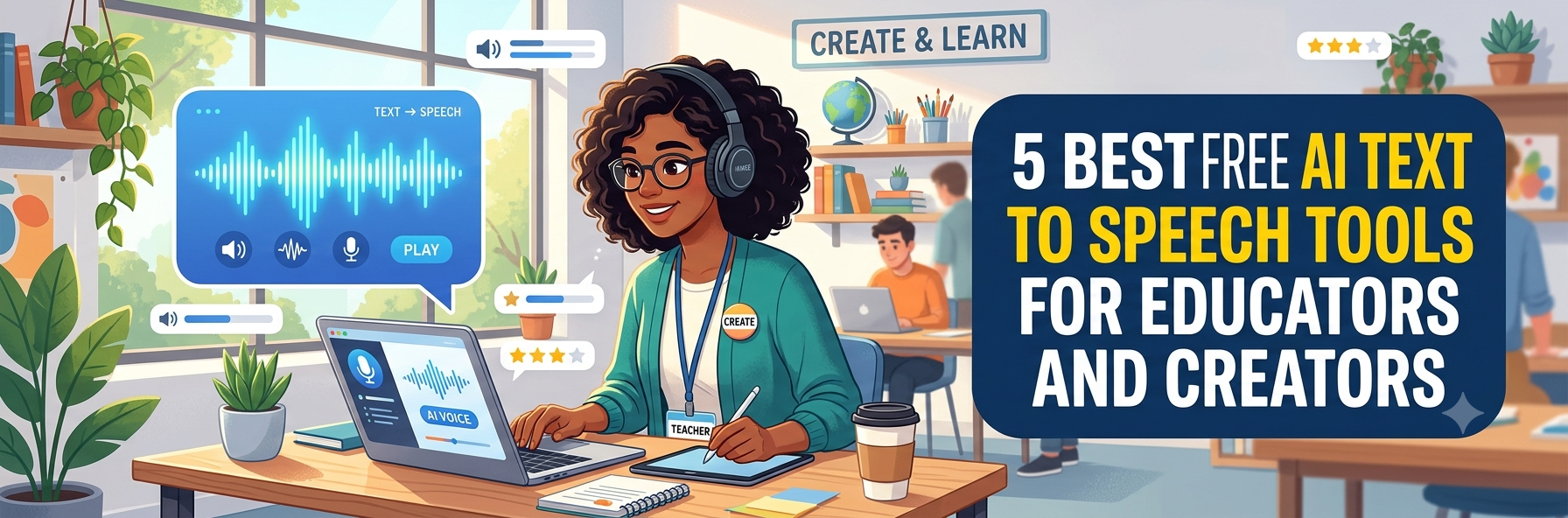
5 Best Free AI Text to Speech Tools for Educators and Creators
Imagine being able to turn a dry, 10-page study guide into an engaging, professional podcast episode in just three clicks. Or think about your students who struggle with reading or have visual impairments—how much would it help them to listen to your lectures on the go?
Voice artificial intelligence has come a long way from the robotic, lifeless voices of the early 2000s. Today’s AI voices sound incredibly human, capturing emotion, pauses, and natural inflections.
If you want to make your learning materials more accessible and engaging, you are in the right place. Today, we are looking at the best free AI text to speech tools for educators and content creators that will give your classroom a brand-new voice.
The Power of Audio in Modern Learning
Multi-sensory learning is no longer just a luxury; it’s a necessity. Combining text with high-quality audio has been proven to improve information retention, help ESL (English as a Second Language) students understand complex terms, and keep busy students engaged while commuting.
Top 5 Free AI Text to Speech Tools
1. ElevenLabs: The Most Realistic AI Voices on Earth
If you want an AI voice that sounds so human it’s almost scary, ElevenLabs is the undisputed champion. Their generative voice technology is widely regarded as the best in the industry.
Why it’s perfect for educators: It doesn’t just read words; it understands context. If a sentence is exciting, the AI voice sounds excited. If it’s a serious academic point, the tone shifts automatically.
The free plan gives you a generous amount of characters every month, allowing you to create short audio summaries, flashcard pronunciations, or brief lecture intros easily.
2. NaturalReader: Built Specifically for Dyslexia and Learning
While some tools focus on content creation, NaturalReader focuses heavily on education and accessibility. It is a lifesaver for students with dyslexia or ADHD.
You can upload PDFs, Word documents, or even snap a picture of a textbook page, and NaturalReader will instantly convert it into clear spoken audio. It also features a web extension, meaning students can listen to any online article or research paper with a single click.
3. Murf.AI: The Ultimate Educational Podcaster
If you are looking to create high-quality e-learning videos, presentations, or school podcasts, Murf.AI is tailored just for you. It offers an all-in-one studio interface where you can time your audio perfectly with slides or video clips.
The free tier gives you access to a massive library of high-quality voices in different languages and accents (British, American, Australian, etc.), making it perfect for language teachers who want students to hear authentic pronunciations.
4. Speechify: Read Faster, Learn Smarter
Founded by a student with dyslexia, Speechify has grown into one of the most popular text-to-speech apps in the world. It is designed to help students and teachers blast through reading assignments.
Speechify allows you to speed up the reading voice up to 4.5x normal speed, which is incredible for skimming through long research drafts. The free version offers great, natural-sounding voices across multiple devices, including iOS, Android, and Chrome.
5. PlayHT: Massive Language and Accent Library
If your classroom is diverse or you teach global subjects, PlayHT is an excellent choice. It features one of the largest directories of AI voices in the market.
PlayHT is great for educators because it allows you to customize pronunciations for complex scientific or historical terms. Once generated, you can easily download your audio files as MP3s to upload directly to Google Classroom or your school’s LMS.
Best Practices for Creating Educational Audio
Before you start converting your entire curriculum into audio, here are a few expert tips to keep your students engaged:
- Keep it bite-sized: Don’t convert a 2-hour lecture into one giant audio file. Break it down into 5 to 10-minute micro-lessons.
- Choose the right tone: Use warm, friendly voices for younger students, and more authoritative, clear voices for high school or college-level research papers.
- Provide the transcript: Always give students the option to read along while they listen. This heavily boosts reading comprehension.
Conclusion: Give Your Lessons a Voice
Education is shifting toward flexibility, and audio is leading the charge. By utilizing the best free AI text to speech tools for educators, you can make your teaching more inclusive, modern, and accessible to every type of learner.
Pick one of these tools, paste your next lesson plan or study guide into it, and see how much your students love the new format!